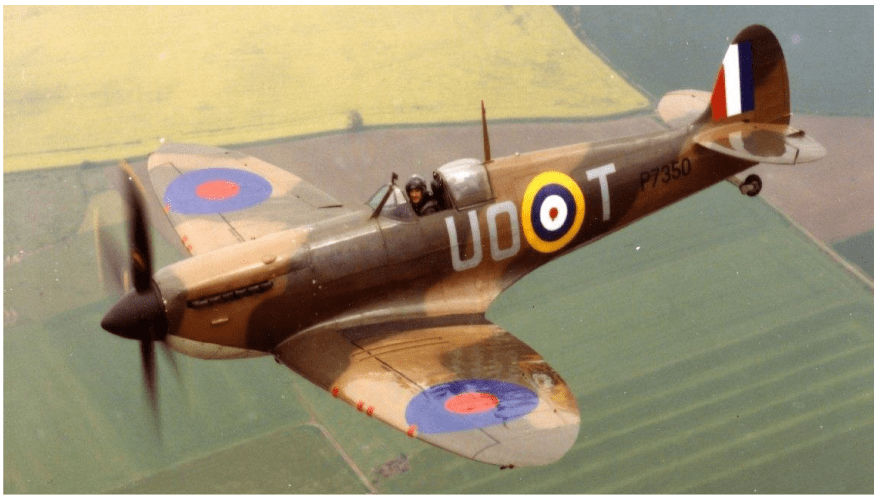
From its humble beginnings and £10,000 prototype budget the Spitfire became one of the most famous and successful aircraft of WW2 and remains the most iconic British aircraft ever built!!
SUPERMARINE SPITFIRE
Supermarine Spitfire MkIIa (BBMF
The Vickers Supermarine Spitfire, designed by Supermarine Aviation Works (Vickers) Ltd initially on a private venture basis, was highly influenced by a desire to offer a higher performance than had been previously achieved by the F.7/30 design. This, combined with a further desire to advance the potential of the Rolls-Royce Merlin and Griffon engines, saw their parallel development form an integral part of the Vickers Supermarine Spitfire story.
Air Ministry Specification F7/30 called for a 4 machine gun carrying fighter aircraft, capable of at least 250 mph, for which Vickers Supermarine submitted the Type 224. It was a bulky, gull-wing, open cockpit monoplane, powered by a 600hp Rolls-Royce Goshawk engine and made its first flight in February 1934. Unfortunately, it was an immediate disappointment to its designer.
An immediate re-think was called for and Chief Designer R.J. Mitchell turned their attention to the previously more successful Schneider Trophy seaplane designs such as the Supermarine S6B. This led to the submission of the Vickers Supermarine Type 300 although this too was rejected by the Ministry. The Supermarine Design Team immediately instigated a number of significant changes, such a enclosing the cockpit and smaller, thinner elliptical wings.
November 1934, saw the introduction of the Rolls-Royce PV-XII V12 engine, later simply known as ‘the Merlin’. This engine, combined with the new submission saw the issue of contract AM361140/34 and Mitchell found himself with £10,000 for the production of a prototype.
New Spitfire Tri car to be
built with 2 litre V10
power!!